
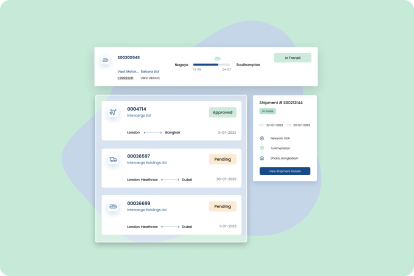
We understand the ever changing needs of our customers

we provide a high level of service dedicated to fulfilling all your shipping requirements

Watch Video
Road Freight

Keep all your data in one place which can be accessed from anywhere and anyplace

Let us help you 24/7 manage your supply chain needs

Back to Global Coverage

China Freight Forwarding Services
Air & Sea Freight Between China And The UK

Intercargo provides reliable freight forwarding services between China and the United Kingdom, helping businesses import and export cargo efficiently by air and sea.

Whether you are importing goods from China into the UK, exporting products from the UK to China, or managing regular international shipments, our experienced freight forwarding team provides complete end-to-end logistics solutions. From supplier collection and customs clearance to final delivery, we manage every stage of the shipping process with efficiency and care.
Logistics solutions
Air Freight China to UK
When speed is essential, our China air freight services provide fast, secure and reliable transportation between China and the United Kingdom.

We arrange air freight through major Chinese airports including Shanghai Pudong International Airport (PVG), Beijing Capital International Airport (PEK), Guangzhou Baiyun International Airport (CAN), Shenzhen Bao'an International Airport (SZX) and Hong Kong International Airport (HKG), with UK arrivals through London Heathrow, London Stansted, Manchester Airport, Birmingham Airport and East Midlands Airport.

Our air freight solutions include:

  • Air freight from China to the UK
  • Express and economy air cargo
  • Door-to-door delivery
  • Time-critical shipments
  • Air freight from the UK to China
  • Airport-to-airport services
  • Customs clearance support
  • High-value and commercial cargo

Whether you need urgent delivery of electronics, manufacturing components, retail stock, machinery or commercial goods, our air freight specialists can provide the most efficient solution.
Logistics solutions
Sea Freight China to UK
For larger shipments and cost-effective transportation, our sea freight services provide dependable shipping solutions between China and the United Kingdom.
We regularly arrange cargo movements through major Chinese ports including Shanghai Port, Ningbo-Zhoushan Port, Shenzhen Port, Qingdao Port, Tianjin Port, Xiamen Port and Guangzhou Port, with UK arrivals through the Port of Felixstowe, Southampton, London Gateway, Liverpool, Tilbury and Immingham.
Our sea freight services include:

  • Full Container Load (FCL)
  • Port-to-port shipping
  • Customs documentation
  • Project cargo
  • Less than Container Load (LCL)
  • Door-to-door logistics
  • Cargo insurance
  • Oversized and heavy-lift shipments

Whether you are shipping machinery, consumer products, electronics, industrial equipment, retail stock or manufacturing materials, our sea freight specialists deliver reliable, flexible and cost-effective shipping solutions between China and the UK.
Logistics solutions
Import from China to the UK
Intercargo helps UK businesses import products and cargo from China through a fully managed freight forwarding service.

Our import services include:

  • Supplier coordination
  • Air and sea freight transportation
  • Duty and VAT guidance
  • Final delivery throughout the UK
  • Collection from Chinese factories, warehouses and commercial premises
  • UK customs clearance
  • Warehousing and distribution

We regularly support imports including:

  • Electronics
  • Consumer goods
  • Automotive parts
  • Industrial equipment
  • Machinery
  • Construction materials
  • Retail stock
  • Textiles & garments
  • Commercial products
Our experienced freight forwarding team ensures your imports from China arrive efficiently, remain fully compliant with UK customs regulations and are delivered on time.
Logistics solutions
Export from the UK to China
We also help UK businesses export goods to customers, distributors and partners throughout China.
Whether shipping to Shanghai, Beijing, Guangzhou, Shenzhen, Ningbo, Qingdao, Tianjin, Chengdu or Hong Kong, our export specialists can arrange a seamless freight solution by air or sea.
Our export services include:

  • Air freight exports
  • Export documentation
  • Cargo insurance
  • Commercial & industrial shipments
  • Sea freight exports
  • Customs compliance
  • Door-to-door delivery

From single shipments to regular freight movements, we provide scalable logistics solutions designed around your business requirements.
Logistics solutions
Customs Clearance & Freight Forwarding
Successful international shipping depends on accurate customs documentation and compliance.

  • Import customs clearance
  • Commodity code guidance
  • Duty and tax assistance
  • End-to-end shipment visibility
  • Export customs clearance
  • Shipping documentation
  • Freight forwarding management

Our experienced freight forwarding team helps minimise delays and keeps your cargo moving smoothly between China and the United Kingdom.
Logistics solutions
Why Choose Intercargo for China Freight?
We support importers, exporters, manufacturers, distributors, retailers and e-commerce businesses moving cargo between China and the UK.
Air Freight And Sea Freight Specialists
Uk And China Trade Lane Expertise
Import And Export Solutions
Customs Clearance Support
Door To Door Logistics
Dedicated Account Management
Global Carrier Network
Competitive Shipping Rates
Get a China Freight Quote

Looking for air freight from China to the UK, sea freight from China to the UK, or export services from the UK to China?

Contact Intercargo today for a tailored freight forwarding quotation and expert advice on the most efficient shipping solution for your cargo.
Logistics solutions
Latest News & Updates

How reliable in predicting spot prices is box ship utilisation?

The relationship between vessel utilisation and container spot freight rates is markedly different on the transpacific and Asia-Europe trades. New analysis from Sea-Intelligence raises questions over how reliably capacity utilisation can predict pricing. The analyst found a strong correlation between utilisation and spot rates on the transpacific, where freight rates rise sharply once vessel utilisation exceeds 90%. However, the relationship is considerably weaker on Asia-Europe, where transhipment activity and geopolitical disruptions complicate the traditional supply-demand equation. Sea-Intelligence compared Drewry's World Container Index (WCI) spot rates with demand data from Container Trade Statistics (CTS) and capacity figures from its own Trade Capacity Outlook database. The analysis used monthly averages, with September's the latest data available, and calculated utilisation by dividing loaded cargo volumes by nominal vessel capacity. On the transpacific, the analysis identified a clear relationship between utilisation and freight rates, with the strongest correlation, 71%, occurring when spot rates lagged changes in utilisation by one month. It said this suggested capacity utilisation was a significant driver of spot rate movements, although other factors also influenced pricing. A further analysis of utilisation against spot rates showed freight rates begin climbing steeply once utilisation passes 90%, reflecting a tightening capacity market in which shippers compete for available slots. The picture on Asia-Europe was markedly different, however, where Sea-Intelligence found a much weaker relationship between utilisation and freight rates, even after applying three-month rolling averages to smooth out short-term volatility. Its correlation analysis and scatter plot showed changes in nominal vessel utilisation were a poor indicator of spot rate movements on the trade, which the analyst suggested reflected fundamental differences in the structure of the two trades. On the transpacific, most vessel capacity is dedicated to cargo moving between Asia and North America, making utilisation a relatively direct measure of the balance between supply and demand, while Asia-Europe is more complex, as vessels carry cargo for multiple markets through major transhipment hubs along their routes. Consequently, capacity that appears available on the main Asia-Europe trade may already be committed to cargo moving on other tradelanes. The analyst also highlighted the impact of the Red Sea and Hormuz crises on vessel deployment, further distorting the relationship between nominal capacity, actual utilisation, and freight rates. Sea-Intelligence acknowledged that its utilisation calculations had limitations, as nominal capacity did not necessarily reflect the actual space available for cargo, while carriers do not disclose precisely how vessel capacity is allocated between trades. The findings suggest that while utilisation can provide a useful signal of impending freight rate increases on the transpacific, applying the same metric to Asia-Europe risks overlooking significant operational and geopolitical factors influencing pricing.

Source: theloadstar.com

Read more

Forwarders warn of Bangkok air cargo delays as congestion continues

Freight forwarders are warning of ongoing shipment delays at Bangkok's main airport as handlers at the Thai hub battle to clear cargo backlogs. The issues started in late September when Bangkok's Suvarnabhumi Airport was hit by severe flooding that stopped staff from being able to attend work. In an update issued this week, freight forwarder Dimerco said that cargo operations at the airport remained severely congested, with the Thai Airways cargo terminal still working through import backlogs that built up in September. "The delays are now affecting both import and export shipments as year-end peak season volumes rise," Dimerco said. The forwarder said that reports suggested there were more than 1,000 outstanding cargo lots and 700-800 pallets awaiting breakdown. At the Thai Airways cargo terminal, "a large volume of inbound cargo is still on PMC pallets awaiting breakdown, which has tied up the pallets and loading equipment needed for outbound cargo", Dimerco said. The forwarder added that operations at the Bangkok Flight Services (BFS) terminal have gradually improved, with export cargo acceptance and staffing returning to more normal levels. "Some backlogs and delays may still occur, particularly during peak periods, and truck queues at the terminal frontage remain long," the company added. Dimerco added that cargo collection at Thai Airways may take several days to weeks while shipments are located and released, while export shipments may be rolled to flights two or three days later than the original booking. The company added that some airlines have placed temporary restrictions on Bangkok bookings while the backlog is cleared. One such airline is Cathay Cargo, which at the start of the month that from 7 to 22 November it would only accept BUP/intact ULD shipments that can be released without breakdown to help reduce the import backlog and improve cargo flow. Singapore Airlines has also reportedly put restrictions in place. Fortune Freight Group said that it had also observed delays at the airport. "We are seeing cargo found within one-two days if you are lucky, but many shipments take around a week or longer. We have also heard that BFS, the other warehouse at the airport, is busy but more under control than Thai Airways." The company warned that extra storage and handling fees may be added to shipments as a result. To keep Thailand-bound shipments moving, Dimerco said that it is offering Air-Truck via Singapore or Hanoi, with onward cross-border road transportation into Thailand, and Air-Air via Singapore, connecting through a partner airline handled at the BFS terminal to bypass Thai Airways.

Source: aircargonews.net

Read more

Project cargo boom in Asia hobbled by inadequate infrastructure

Demand for project cargo across Asia is expected to surge in the near term, but the industry's capacity to transport such shipments is struggling to keep pace with the rapid development of projects. At Breakbulk Asia in Singapore today, MSC's head of project cargo, Ben Collins, said the region was becoming increasingly important to the successful execution of major infrastructure and industrial projects. "Vietnam has an emerging nuclear power programme; Asia is very central to the supply and successful delivery of these projects, so it's time for optimism and bullishness." AAL Shipping's commercial chief, Felix Schoeller, explained that geopolitical developments had accelerated the relocation and expansion of engineering, procurement, and construction (EPC) activities in Asia. "There has been a big push in the last 10 years, going back to the first Trump administration, which resulted in the China Plus One strategy, boosting manufacturing capacity across South-east Asia and India," he said. However, some executives warned that inadequate landside infrastructure and logistical constraints could hamper the movement of oversize and heavy cargo. Kohki Uemura, CEO of Japanese heavylift forwarder Denzai, identified road and bridge infrastructure as a major bottleneck when transporting modules weighing between 500 and 1,500 tonnes, adding: "Roads and bridges are not enough for such heavy cargo." Yohan Beal, Ceva Logistics' operations director for Asia Pacific, said responsibility for addressing these challenges rested with the parties conducting logistics surveys and overseeing project requirements. "Is due diligence being done?" he asked. "Can I make sure that I can actually get the cargo out of the port? Can I actually deliver the cargo from the port to the final destination? "Those are the parameters we need to ascertain before we actually fix the port of discharge and the final route we take," he added. Mr Beal noted that project owners and EPC contractors were increasingly recognising the importance of incorporating logistics considerations at an early stage, leading them to involve specialist logistics providers earlier in the planning process. "Since the pandemic, people who used to be underappreciated in the logistics field are now making their way to the boardrooms. Clients now seek approval before purchase orders are signed," he said. Mr Collins echoed the call for earlier planning, cautioning project owners against prioritising short-term cost savings at the expense of future transportation requirements. "Don't be dictated by looking for a cheaper price tomorrow... what you might have to move today is going to cost you more tomorrow," he said.

Source: theloadstar.com

Read more

Privacy Preference Center

This website uses cookies and similar technologies, (hereafter “technologies”), which enable us, for example, to determine how frequently our internet pages are visited, the number of visitors, to configure our offers for maximum convenience and efficiency and to support our marketing efforts. These technologies incorporate data transfers to third-party providers based in countries without an adequate level of data protection (e. g. United States). For further information, including the processing of data by third-party providers and the possibility of revoking your consent at any time, please see your settings under “Consent Preferences” and our Privacy Notice.


Manage Consent Preferences
Strictly Necessary Cookies
Always Active

Performance Cookies

Functional Cookies

Targeting Cookies