Discover your all-in-one digital freight platform
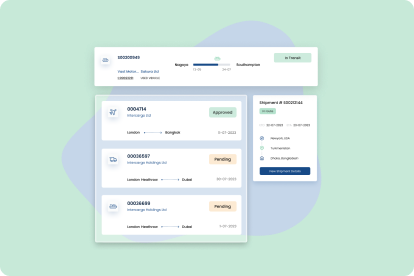
Escape the chaos of calls, faxes, and endless emails. Step into a connected world where suppliers, shippers, customs, ports, and more unite on a single platform for seamless, contextual collaboration

Let us help you 24/7 manage your supply chain needs










Being an IATA accredited agent we have access to over 149 airlines, this includes scheduled freighters and passenger aircrafts.

With our LCL service, you can ship as little or as much as you like, weekly consoles are our business and get you yours.

We provide comprehensive road freight services, covering both Less-Than-Truckload (LTL) and Full-Truckload (FTL) options.
To meet your requirements we have access to vehicles of all sizes from small vans to artic with 24/7 availability and live tracking.
Escape the chaos of calls, faxes, and endless emails. Step into a connected world where suppliers, shippers, customs, ports, and more unite on a single platform for seamless, contextual collaboration




Air cargo boom collides with the rising cost of aviation
Global economic growth and the particular strength of the technology and manufacturing sectors have left the airfreight industry riding high. That said, the sector finds itself uniquely pinched by factors outside its control. Those factors, of course, include runaway fuel prices. But cargo airlines, aircraft lessors and freighter conversion shops are also reeling from the surging expense of acquiring aircraft and engines, and then maintaining those assets. Lease rates for older Boeing 777-300ERs - prime candidates for cargo conversions - have increased $200,000 monthly in the last two years, partly because passenger airlines are holding on to such types, Anna Kopinski, director of asset valuations at mBa Aviation, said last week at the Cargo Facts Symposium in Nashville. Another example: the oldest 777s were worth about $30m at end-2024. "Now, you can't get a half-time aircraft for anything under [$40-45m]," Kopinski adds. "That's a lot of capital." The inflated values come amid a period of strength for airfreight. "Cargo demand is outpacing cargo capacity," Pooja Gardemal, managing director of aircraft appraisal firm BK Associates, said at the event. Airfreight demand increased 4.4% year on year in August, buoyed by a rising manufacturing sector, IATA reported in its most recent monthly air cargo market analysis, with growth concentrated in North America and Asia Pacific. Meanwhile, Airbus predicts airlines over the next 20 years will need 2,670 additional freighters, including 1,140 small, 860 midsize widebody and 670 large widebody jets, according to its 2026 Global Market Forecast, released last week. "It has been a very robust year," says FedEx Logistics president Marcus Balzereit, citing "immense growth" in the manufacturing, healthcare, technology, automotive and aerospace sectors. Meeting that demand while making the economics work is the trick. George Dimitroff, head of valuations at fleet consultancy Cirium Ascend, says midlife 737-800s are now changing hands for about $20m. Paying that much and then converting the aircraft to a freighter is economically feasible, he adds. Engines are driving much of the price spike, a consequence of high demand for, and limited supply of, new engines, used engines, spare parts and maintenance capacity. Even "unserviceable" CFM International CFM56-7Bs, which power 737NGs, have recently been selling for $7m, "which is unheard of in my career", Dimitroff says. Parts shortages are so acute that MTU Aero Engines North America this year purchased 15 GE Aerospace CF6s solely for access to the engines' life-limited parts, says vice president of sales and marketing Les Cronin. Maintenance expenses are equally frustrating. "We've seen maintenance costs rise incredibly," says mBa's Kopinski. Have a Rolls-Royce turbofan that needs overhauling? Expect to wait one year for a maintenance slot, then another four months for the work to be completed, says Titan Aviation Leasing's vice-president of technical, Juan Zapata. Some maintenance shops are needing more time - six months - to complete overhauls, or about twice as long as previously, says Western Global Airlines chief executive James Neff. Want to scoop up an engine from the aftermarket? Good luck. "We're starting to see this continuous shortage of engines available in the market", which "drives up the prices", says Zapata. Challenge Group, which owns several cargo airlines, has so far been successful in acquiring aircraft already equipped with engines, but the severity of the problem leaves operators facing the prospect of acquiring engine-less airframes, then later sourcing turbofans, says Challenge chief commercial officer Or Zak: "There's not much more that we can do." Prices will likely remain elevated and capacity will remain tight for the foreseeable future, until aircraft manufacturers accelerate new-jet production. Then, more used aircraft will become available and prices will ease, executives say. "I think we're looking at post-2030 before you see feedstock values for the 777-300ERs coming down to a point where it's once again a viable [conversion] option," says Kopinski.
Source: aircargonews.net
Read more
Davies Turner to establish new airfreight HQ outside Heathrow
Davies Turner has acquired a logistics facility close to Heathrow Airport that will become the new headquarters of Davies Turner Air Cargo. The facility is currently being prepared for occupation, with an official opening scheduled for later this year. Its acquisition represents one of the most significant property investments in the UK-based independent freight forwarding group's recent history, the company said. The 130,000 sq ft facility is located less than two miles (3.2km) from Heathrow Airport's cargo terminal and just 500 yards from Junction 14 of the M25, the orbital motorway that surrounds London. It comprises approximately 70,000 sq ft of high-specification warehousing, with 12.5m clear internal height, and two mezzanine floors providing a further 50,000 sq ft of operational space. The site features five dock-loading doors and two level-access loading doors, together with 10,000 sq ft of office accommodation Davies Turner said that the acquisition forms part of its long-term strategy to "invest in critical logistics infrastructure that supports customer growth, operational excellence and future expansion". The new site has been selected to "strengthen the company's capacity, improve efficiency and provide a modern, future-ready environment for both employees and customers", it added. James Wheatley, managing director of Davies Turner Air Cargo, stated: "This acquisition represents a major milestone for Davies Turner Air Cargo and demonstrates our long-term commitment to the UK airfreight market. "Heathrow remains the country's premier international cargo gateway and this strategically located facility provides an exceptional platform from which to support our customers' future growth." He observed: "The investment gives us the capacity, infrastructure and operational flexibility required to continue developing our services for many years to come." Meanwhile, the long-running saga of Heathrow's own expansion rumbles on. Earlier this month, the airport indicated that the opening of its planned third runway is likely to be closer to 2039 than 2035. In its first quarter 2025 results, published on 30 April 2025, it said that depending on the UK Government's response, it aimed for the third runway to be operational by 2035. But in January 2026, Heathrow said the UK Government timetable was to secure planning permission by 2029 and bring the runway into operation within a decade, up to 2039. And, in a recently issued statement to Reuters, a spokesperson for Heathrow said that 2035 had been an "ambitious target". The airport added: "Our focus has always been to secure planning permission by 2029. Once achieved the runway will be open within a decade."
Source: aircargonews.net
Read more
DSV air volumes hit by weak Europe and reduced Asia-Europe e-commerce
DSV's airfreight business faced third quarter challenges including weak activity in Europe and reduced Asia Pacific-Europe e-commerce demand. Airfreight volumes fell by 3% to 560,890 tonnes in the third quarter compared to the third quarter of 2025. Overall, volumes grew 15% year on year in the first nine months of 2026. As well as reduced e-commerce shipment volumes on the Asia Pacific-Europe trade lane and Europe-APAC volumes that were below expected levels, the Denmark-headquartered freight forwarder said its air volumes were also negatively impacted by yield management initiatives and shippers shifting cargo from air to sea transport. Meanwhile, DSV pointed out that the Middle East conflict continued to disrupt global airfreight networks, leading to higher costs and volatility, flight rerouting and reduced effective capacity. Although technology, including cloud, demand in in APAC and North America helped lift volumes. "Despite a positive volume trend during the quarter, the decline was larger than expected. Volumes were impacted by yield-management initiatives, conversion from air freight to sea freight, lower-than expected activity in Europe and reduced e-commerce volumes on the APAC-Europe trade lane. "This was partially offset by growth within Technology business in APAC and North America. Middle East-related trade lanes remained weak due to the ongoing conflict in the region." Despite the drop in volumes, airfreight revenue for the quarter was up 16.6% to Dkr24.6bn and air gross profit improved 4.3% to Dkr5bn. DSV commented that average gross profit yields increased "8% YoY in constant currencies". Revenue for the air and sea division was Dkr45.5bn, up by 15.9% in constant currencies terms. This was "mainly driven by increased freight rates and surcharge recovery, especially in air freight", said DSV. Meanwhile, gross profit was Dkr9.2bn. This was an increase of 0.2% year on year, dragged down by the performance of the sea business, where gross profit was down 4.2% "Gross profit was affected by negative volume growth in certain European markets, as well as the transfers of certain services to Global Products," said DSV. "Adjusted for these transfers, gross profit increased 2.8% YoY." It further stated: "In constant currencies, the gross profit was on level with last year. Higher average gross profit yields for air freight and integration synergies were offset by lower freight volumes across both air and sea freight." Across the whole business DSV reported revenue of Dkr80.6bn, up 12% year on year. DSV reported gross profit of Dkr20.3bn, an increase of 2.3% compared to the same period last year. Jens Lund, DSV Group chief executive, said: "We delivered earnings growth in a volatile market, driven by strong results in Air & Sea and Contract Logistics. "Road was affected by integration-related operational issues, but service levels recovered by quarter-end, allowing us to shift our focus to productivity, commercial initiatives and organic growth. "We remain focused on completing the Schenker integration, realising synergies and advancing our 2030 ambitions through investments in AI, technology and network optimisation." Schenker integration The integration of Schenker has largely continued as planned, said DSV. At the end of the third quarter, almost all of the countries with operations "have either completed integration or are in the process of integrating". However, there are a small number of countries where integration is expected to start during the fourth quarter. The Road division in particular has seen operational and commercial challenges in certain European markets following the integration. "Annual synergies are still expected to be at the level of DKK 9 billion, partly offset by inflationary pressure and costs related to increased activity in Contract Logistics," said DSV. "The remaining synergies related to Road and certain Group functions are expected to be delayed into 2027 due to the operational issues in Road."
Source: aircargonews.net
Read more
This website uses cookies and similar technologies, (hereafter “technologies”), which enable us, for example, to determine how frequently our internet pages are visited, the number of visitors, to configure our offers for maximum convenience and efficiency and to support our marketing efforts. These technologies incorporate data transfers to third-party providers based in countries without an adequate level of data protection (e. g. United States). For further information, including the processing of data by third-party providers and the possibility of revoking your consent at any time, please see your settings under “Consent Preferences” and our Privacy Notice.